After five months of intense conflict with Iran, the U.S. military has depleted up to 80% of key missile interceptors like THAAD, roughly half of its Patriot and Tomahawk inventories, and nearly all long-range precision surface missiles (ATACMS/PrSM). While the Pentagon denies readiness crises, analysts warn replenishment will take years.
QESHM ISLAND, IRAN – APRIL 28: The Ateela 2 Oil Tanker boat navigates the sea on April 28, 2026 on Qeshm Island, Iran in the Strait of Hormuz. Iran’s latest proposal for ending its blockade of the Strait of Hormuz calls on the United States to end its naval blockade of Iran’s ports, and sets aside questions about what to do with Iran’s nuclear program. The United States has not formally responded to the latest proposal, which was delivered by Iran’s foreign minister to Pakistan two days ago. (Photo by Asghar Besharati/Getty Images)
The Cost of High-Tech Warfare in the Middle East Missile
The ongoing military campaign against Iran has placed an unprecedented logistical strain on United States armed forces. Recent internal inventory leaks and reports highlighted by major defense trackers reveal that high-volume use of sophisticated munitions has rapidly drained strategic reserves.
Which Stockpiles Are Hit Hardest?
The expenditure rate during the conflict has outpaced peacetime manufacturing capabilities by a wide margin. Key systems experiencing severe shortages include:
THAAD Interceptors: Exhausted by nearly 80% compared to pre-war baseline numbers.
Patriot Systems: Roughly half to 65% of regional and global interceptors have been burned through.
Long-Range Precision Missiles: Virtually all Army Tactical Missile Systems (ATACMS) and Precision Strike Missiles (PrSM) have been heavily drawn down or exhausted.
Tomahawk Cruise Missiles: Just under half of the global inventory has been expended in strikes from naval platforms.
Strategic Readiness and Global Risk
Defense analysts from organizations like the Center for Strategic and International Studies warn that these rapid drawdowns jeopardize global defense posture. With inventories diminished, questions arise over the U.S. military’s capacity to simultaneously deter or respond to major contingencies in other theaters, such as the Indo-Pacific or Eastern Europe. Manufacturing bottlenecks mean that scaling production back up to safe reserve limits will likely require three to four years of dedicated industrial surge.
Oil tankers and gas tankers were affected by the closure of the Strait of Hormuz, leading to a global energy crisis stemming from the war in the Middle East.(Aerial view)
Rebuilding the Arsenal: The Defense Production Act and Industry Surge
To combat the massive manufacturing bottlenecks delaying the replenishment of high-end stockpiles, the White House issued a critical directive using the Defense Production Act (DPA). This executive authority allows defense companies to work in close coordination, bypassing traditional antitrust barriers to resolve supply chain deadlocks.
The primary goals of this industrial push include:
Shoring Up Sub-Systems: Resolving critical shortages in solid rocket motors, specialized igniters, and precision guidance systems.
Expanding Factory Footprints: Facilitating $3 billion in joint framework agreements to triple PAC-3 (Patriot) component manufacturing and quadruple THAAD rocket motor production.
Transitioning to New Systems: Winding down older ATACMS pipelines to prioritize the high-volume production of next-generation Precision Strike Missiles (PrSM) by late 2027.
Despite these mobilization efforts, defense policy experts point out that the Pentagon cannot simply “flip a switch” to yield immediate results. Rebuilding the core elements of the U.S. missile inventory remains a multi-year effort heavily tied to long lead times for raw aerospace components.
Global Allocation and Allied Delays
The rapid consumption of U.S. interceptors creates a difficult zero-sum game for foreign military sales and existing global commitments. With Washington forced to retain its current interceptor output to refill its own domestic reserves, international partners are already feeling the operational ripple effects.
The Indo-Pacific: Scheduled deliveries of over 400 specialized air-defense missiles to Japan face imminent delays. This bottleneck complicates Tokyo’s regional deterrence plans just as its navy finishes necessary fleet modifications.
Eastern Europe: Ukraine has reported a severe drop-off in Patriot interceptor replenishments compared to previous operational years. This scarcity underscores the strain on global stockpiles as multiple active theaters vie for the exact same manufacturing lines.
The Middle East: While the White House previously cleared billions in secondary air defense sales to Gulf allies like Kuwait, Bahrain, and the UAE, analysts project that these defense exports will soon face timeline freezes to prioritize American strategic readiness.
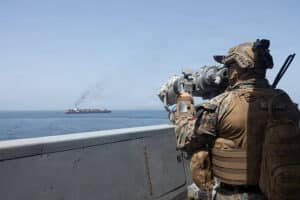
ARABIAN SEA – APRIL 20: (EDITOR’S NOTE: This Handout image was provided by a third-party organization and may not adhere to Getty Images’ editorial policy.) In this handout photo provided by U.S. Central Command, U.S. forces patrol the Arabian Sea near M/V Touska on April 20, 2026, after firing upon the Iranian-flagged vessel that the U.S. accused of attempting to violate the U.S. naval blockade of Iranian ports near the Strait of Hormuz. (Handout Photo by the U.S. Navy via Getty Images)
Ultimately, the conflict highlights a significant vulnerability in modern high-tech warfare: the rapid, asymmetrical burn rate of multi-million dollar defensive systems against cheaper, mass-produced threats. As the defense industry pivots to meet this massive demand, the U.S. military must carefully balance active engagement against the long-term reality of a depleted arsenal.
After five months of intense conflict with Iran, the U.S. military has depleted up to 80% of key missile interceptors like THAAD, roughly half of its Patriot and Tomahawk inventories, and nearly all long-range precision surface missiles (ATACMS/PrSM). While the Pentagon denies readiness crises, analysts warn replenishment will take years.
QESHM ISLAND, IRAN – APRIL 28: The Ateela 2 Oil Tanker boat navigates the sea on April 28, 2026 on Qeshm Island, Iran in the Strait of Hormuz. Iran’s latest proposal for ending its blockade of the Strait of Hormuz calls on the United States to end its naval blockade of Iran’s ports, and sets aside questions about what to do with Iran’s nuclear program. The United States has not formally responded to the latest proposal, which was delivered by Iran’s foreign minister to Pakistan two days ago. (Photo by Asghar Besharati/Getty Images)
The Cost of High-Tech Warfare in the Middle East Missile
The ongoing military campaign against Iran has placed an unprecedented logistical strain on United States armed forces. Recent internal inventory leaks and reports highlighted by major defense trackers reveal that high-volume use of sophisticated munitions has rapidly drained strategic reserves.
Which Stockpiles Are Hit Hardest?
The expenditure rate during the conflict has outpaced peacetime manufacturing capabilities by a wide margin. Key systems experiencing severe shortages include:
THAAD Interceptors: Exhausted by nearly 80% compared to pre-war baseline numbers.
Patriot Systems: Roughly half to 65% of regional and global interceptors have been burned through.
Long-Range Precision Missiles: Virtually all Army Tactical Missile Systems (ATACMS) and Precision Strike Missiles (PrSM) have been heavily drawn down or exhausted.
Tomahawk Cruise Missiles: Just under half of the global inventory has been expended in strikes from naval platforms.
Strategic Readiness and Global Risk
Defense analysts from organizations like the Center for Strategic and International Studies warn that these rapid drawdowns jeopardize global defense posture. With inventories diminished, questions arise over the U.S. military’s capacity to simultaneously deter or respond to major contingencies in other theaters, such as the Indo-Pacific or Eastern Europe. Manufacturing bottlenecks mean that scaling production back up to safe reserve limits will likely require three to four years of dedicated industrial surge.
Oil tankers and gas tankers were affected by the closure of the Strait of Hormuz, leading to a global energy crisis stemming from the war in the Middle East.(Aerial view)
Rebuilding the Arsenal: The Defense Production Act and Industry Surge
To combat the massive manufacturing bottlenecks delaying the replenishment of high-end stockpiles, the White House issued a critical directive using the Defense Production Act (DPA). This executive authority allows defense companies to work in close coordination, bypassing traditional antitrust barriers to resolve supply chain deadlocks.
The primary goals of this industrial push include:
Shoring Up Sub-Systems: Resolving critical shortages in solid rocket motors, specialized igniters, and precision guidance systems.
Expanding Factory Footprints: Facilitating $3 billion in joint framework agreements to triple PAC-3 (Patriot) component manufacturing and quadruple THAAD rocket motor production.
Transitioning to New Systems: Winding down older ATACMS pipelines to prioritize the high-volume production of next-generation Precision Strike Missiles (PrSM) by late 2027.
Despite these mobilization efforts, defense policy experts point out that the Pentagon cannot simply “flip a switch” to yield immediate results. Rebuilding the core elements of the U.S. missile inventory remains a multi-year effort heavily tied to long lead times for raw aerospace components.
Global Allocation and Allied Delays
The rapid consumption of U.S. interceptors creates a difficult zero-sum game for foreign military sales and existing global commitments. With Washington forced to retain its current interceptor output to refill its own domestic reserves, international partners are already feeling the operational ripple effects.
The Indo-Pacific: Scheduled deliveries of over 400 specialized air-defense missiles to Japan face imminent delays. This bottleneck complicates Tokyo’s regional deterrence plans just as its navy finishes necessary fleet modifications.
Eastern Europe: Ukraine has reported a severe drop-off in Patriot interceptor replenishments compared to previous operational years. This scarcity underscores the strain on global stockpiles as multiple active theaters vie for the exact same manufacturing lines.
The Middle East: While the White House previously cleared billions in secondary air defense sales to Gulf allies like Kuwait, Bahrain, and the UAE, analysts project that these defense exports will soon face timeline freezes to prioritize American strategic readiness.
ARABIAN SEA – APRIL 20: (EDITOR’S NOTE: This Handout image was provided by a third-party organization and may not adhere to Getty Images’ editorial policy.) In this handout photo provided by U.S. Central Command, U.S. forces patrol the Arabian Sea near M/V Touska on April 20, 2026, after firing upon the Iranian-flagged vessel that the U.S. accused of attempting to violate the U.S. naval blockade of Iranian ports near the Strait of Hormuz. (Handout Photo by the U.S. Navy via Getty Images)
Ultimately, the conflict highlights a significant vulnerability in modern high-tech warfare: the rapid, asymmetrical burn rate of multi-million dollar defensive systems against cheaper, mass-produced threats. As the defense industry pivots to meet this massive demand, the U.S. military must carefully balance active engagement against the long-term reality of a depleted arsenal.
A new investigative report reveals that total remodeling and construction efforts on the White House grounds under President Donald Trump have reached at least...
Following devastating Iranian missile and drone strikes on Naval Support Activity Bahrain, the U.S. Navy relocated its primary Middle East logistics hub to the...
Want to stay up to date with the latest news?
We would love to hear from you! Please fill in your details and we will stay in touch. It's that simple!
Used by Google Analytics to determine which links on a page are being clicked
30 seconds
_ga_
ID used to identify users
2 years
_gid
ID used to identify users for 24 hours after last activity
24 hours
_gat
Used to monitor number of Google Analytics server requests when using Google Tag Manager
1 minute
_gac_
Contains information related to marketing campaigns of the user. These are shared with Google AdWords / Google Ads when the Google Ads and Google Analytics accounts are linked together.
90 days
__utma
ID used to identify users and sessions
2 years after last activity
__utmt
Used to monitor number of Google Analytics server requests
10 minutes
__utmb
Used to distinguish new sessions and visits. This cookie is set when the GA.js javascript library is loaded and there is no existing __utmb cookie. The cookie is updated every time data is sent to the Google Analytics server.
30 minutes after last activity
__utmc
Used only with old Urchin versions of Google Analytics and not with GA.js. Was used to distinguish between new sessions and visits at the end of a session.
End of session (browser)
__utmz
Contains information about the traffic source or campaign that directed user to the website. The cookie is set when the GA.js javascript is loaded and updated when data is sent to the Google Anaytics server
6 months after last activity
__utmv
Contains custom information set by the web developer via the _setCustomVar method in Google Analytics. This cookie is updated every time new data is sent to the Google Analytics server.
2 years after last activity
__utmx
Used to determine whether a user is included in an A / B or Multivariate test.
18 months
You can find more information in our Privacy Policy and .